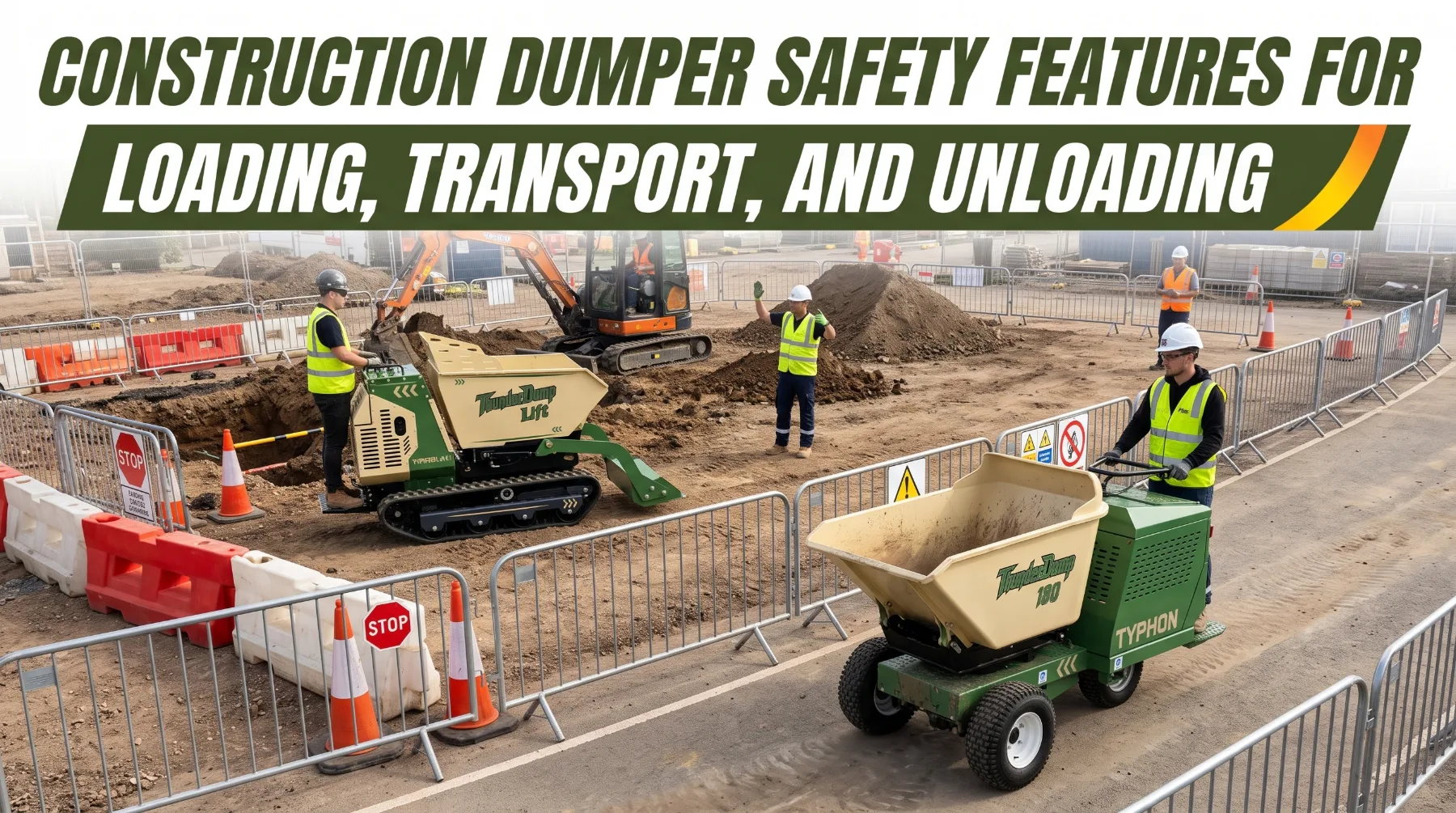
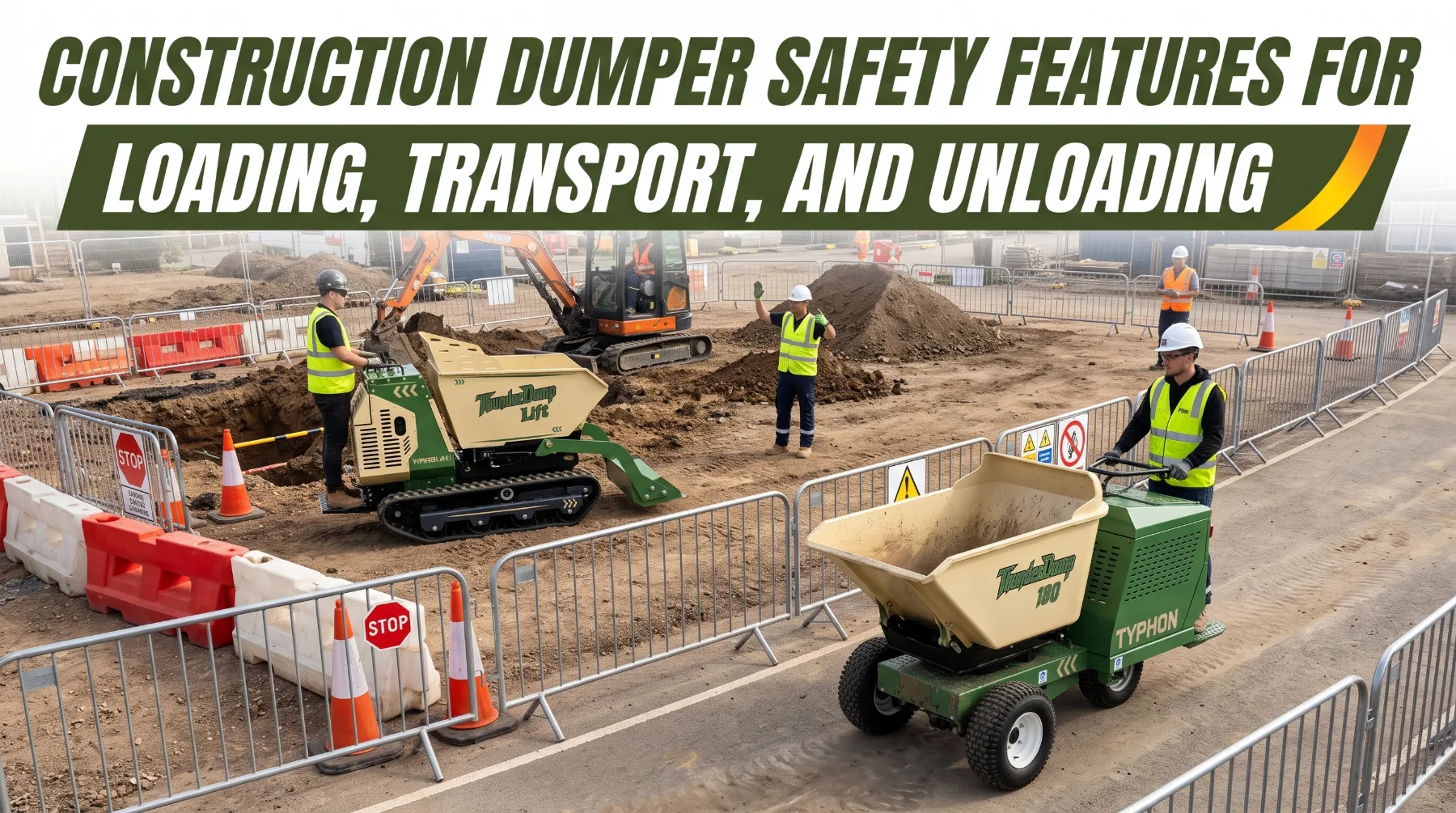
An excavator loads a site dumper with wet clay at the edge of a foundation dig. The load is heaped high, and the operator can barely see over it. The dumper sets off down a temporary haul route that rain has softened overnight, turns sharply at the bottom of a ramp, and heads for a spoil heap near an open trench. Each of these moments carries risk: an overloaded hopper, a blocked view, soft ground, a sharp turn, and an unloading point too close to an edge. A dumper's safety features are designed to manage exactly these risks, but only when they work correctly and operators use them as intended.
Construction dumpers move soil, aggregate, sand, concrete, and demolition debris around jobsites every day. Their brakes, payload ratings, hopper locks, warning systems, and protective structures help operators control the machine through every stage of the material-handling cycle. Combined with sound operating procedures, these features reduce the risk of overloading, collisions, and instability.
Braking and Travel Controls
Every safe dumper cycle depends on the operator's ability to control speed, steer accurately, and stop when needed. The service brakes slow and stop the dumper during travel, while the parking brake holds it in place when the operator stops to load, unload, or leave the seat. Both systems must work reliably, especially on ramps and slopes where a loaded dumper carries far more momentum than an empty one. Before each shift, test the service brakes at low speed on level ground and confirm the parking brake holds the machine securely. Always apply the parking brake before leaving the operator's position, and lower the hopper fully where the manufacturer instructs.
Steering must respond predictably across the full range of movement. Many site dumpers use articulated steering, where the front and rear sections pivot at a central joint. That design allows tight turning but changes how the machine behaves on slopes and at speed. Stiff, delayed, or uneven steering can cause an operator to overcorrect, raising the risk of tipping. Before carrying any load, confirm that steering moves smoothly from lock to lock without binding, that forward, reverse, and neutral controls engage correctly, and that throttle and speed controls return to their default positions when released.
The horn, reversing alarm, and beacons warn people nearby that the dumper is moving. Test each one before starting work. A dumper with a silent reversing alarm or a failed beacon removes an important layer of protection, particularly on busy sites where other machines and workers share the same space. If the brakes, steering, or travel controls aren't working correctly, don't operate the dumper. Report the fault, tag the machine out of service according to site procedures, and wait for a qualified repair.
Key takeaway: Test the service brakes, parking brake, steering, travel controls, and warning devices before every shift, and never operate a dumper whose brakes or steering aren't functioning correctly.
Visibility and Warning Systems
Dumpers often work in congested areas alongside excavators, loaders, trucks, and workers on foot. Restricted visibility is a leading factor in collisions involving site dumpers, so visibility aids and warning systems play a central role in protecting the people around the machine. Mirrors extend the operator's view to the sides and rear, while cameras can cover blind spots that mirrors can't reach. Some dumpers include forward-facing cameras to help operators see past a loaded hopper. Where these features are fitted, they must be clean, correctly adjusted, and working before the machine moves.
Lights help the operator see in low light and help others see the dumper. Beacons signal that the machine is active. Horns allow the operator to warn people deliberately, while reversing alarms provide an automatic warning when the dumper backs up. Some machines also include proximity detection systems that alert the operator when a person or object is nearby. Build these checks into every start-up routine: confirm mirrors are clean and correctly positioned, camera lenses and displays are working, headlights and beacons function correctly, and the horn and reversing alarm are audible over typical site noise.
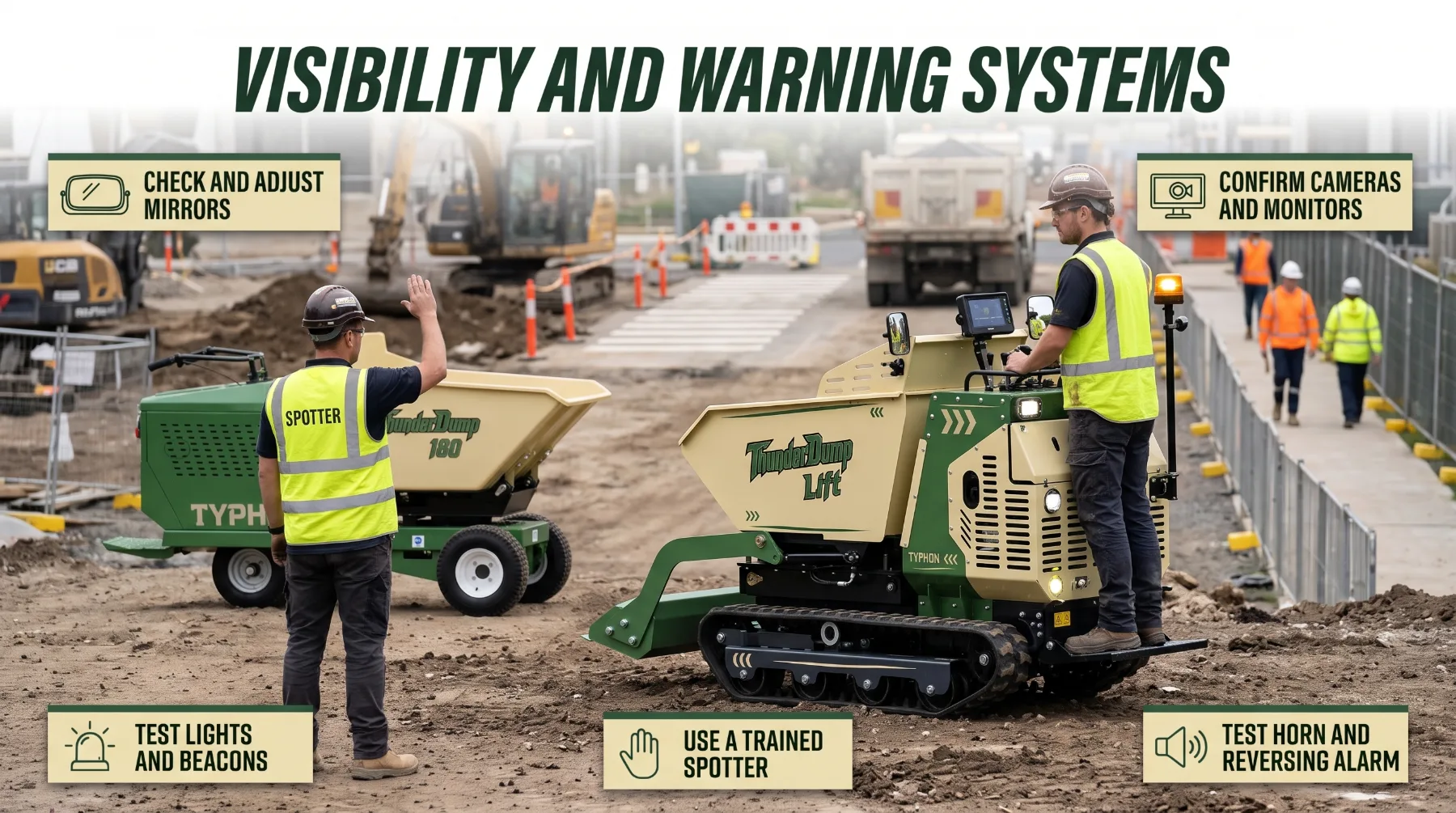
When visibility is restricted, use a trained spotter. Spotters are especially valuable when reversing, working near excavations, discharging into confined areas, or traveling through crowded zones. Agree on clear hand signals before work begins, and make sure the spotter stays visible to the operator and outside the dumper's travel path. If the operator loses sight of the spotter, the dumper should stop. Separate dumper routes from pedestrian walkways wherever possible, and use barriers, signage, and marked crossing points to control where people and machines meet.
Key takeaway: Check mirrors, cameras, lights, beacons, horns, alarms, and detection systems before work, keep travel routes separated from pedestrians, and use a trained spotter whenever visibility is restricted.
Payload Ratings and Load Distribution
A dumper's stability starts with the load it carries. Rated payload is the maximum load weight the manufacturer permits under specified conditions. It is different from hopper volume, which describes how much space is available inside the hopper. The dumper must stay within its payload rating no matter how much room remains. Material density decides which limit you reach first. Wet soil, clay, crushed stone, and broken concrete are dense and can reach the payload limit while the hopper is only partly full. Dry topsoil, mulch, and light debris often fill the hopper before approaching the weight limit. Overloading raises the center of gravity, reduces braking and steering performance, and strains the hydraulic cylinder, pivots, axles, and tires or tracks.
A load can stay within the rated payload and still be unsafe if it is unevenly distributed. Material piled to one side shifts the center of gravity toward that side, while loose or irregular material such as rubble, rock, or long timber can move during travel and change the machine's balance without warning. Load the hopper evenly and centrally, place heavy pieces low, and avoid letting material overhang the edges. Brief excavator and loader operators on fill levels for each material type so they place loads gently rather than dropping heavy pieces from height.
On many forward-tipping site dumpers, the hopper sits in front of the operator, meaning a heaped load can block the view of the route ahead, including people, obstacles, and changes in ground level. Never carry a load that obstructs the operator's line of sight. If a load must be heaped, reduce it, choose a different machine, or follow site procedures for restricted visibility such as using a trained spotter.
Key takeaway: Stay within the manufacturer's rated payload regardless of hopper space, load evenly and centrally to prevent shifting, and never carry material that blocks the operator's view of the route ahead.
Hopper Locks and Tipping Systems
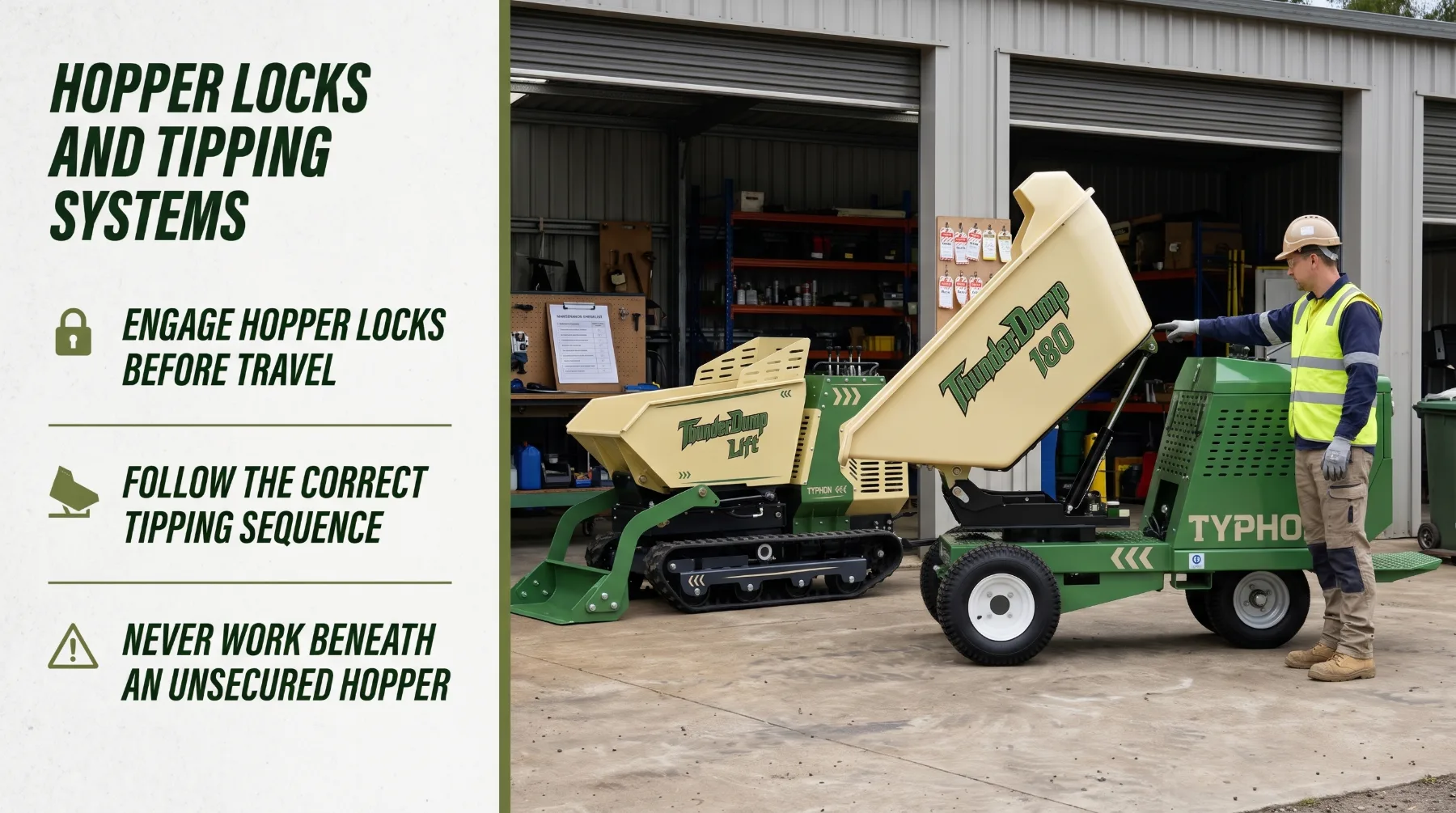
The hopper is where most of a dumper's work happens, and it is also the source of some of its most serious hazards. Depending on the design, a dumper may include a hopper lock, latch, or hydraulic hold that keeps the hopper secure in its travel position. On swivel-hopper models, a separate lock may hold the hopper in a fixed direction. These devices prevent unintended movement while the machine travels over rough ground or slopes. Confirm that every hopper lock engages fully before moving off, and inspect latches and pins for wear, damage, or looseness before each shift.
Operators should follow the manufacturer's tipping sequence for their specific machine. The correct approach is to arrive at the discharge point slowly on firm, level ground, stop and apply the parking brake, confirm no one is in the discharge zone, check overhead clearance on high-tip models, release any hopper lock as instructed, and raise or tilt the hopper smoothly using the approved controls. Once unloading is complete, lower the hopper fully and re-engage the lock before moving off. Smooth, gradual tipping keeps the load flowing evenly and reduces sudden shifts in balance. Abrupt control inputs can jolt the machine and release material unpredictably.
Some maintenance and inspection tasks require the hopper to stay raised. For these situations, manufacturers specify approved safety devices such as a hopper prop, safety strut, or mechanical lock. Use only the device the manufacturer specifies for that machine, and follow the correct procedure for fitting it. Hydraulic pressure alone must never be relied on to hold a raised hopper, since a hose failure, valve fault, or accidental control movement can drop it without warning. Never place your head, hands, or body beneath a raised hopper unless the machine has been properly secured using the manufacturer's specified procedure, which typically includes shutting down the engine, removing the key, fitting the approved support device, and completing any required isolation steps.
Key takeaway: Engage hopper locks before travel, follow the manufacturer's tipping sequence, use only approved safety supports, and never place any part of the body beneath a raised hopper unless it has been properly secured.
Stability During Travel and Unloading
Dumper overturns are among the most serious incidents on construction sites. They often happen when a loaded machine meets soft ground, a slope, a sharp turn, or an unloading point too close to an edge. Soft fill, saturated soil, and uneven surfaces can let a wheel or track sink suddenly, tilting the machine toward the low side. Ruts, potholes, and loose spoil can jolt the dumper and shift the load. Inspect haul routes at the start of each shift and after rain, and maintain them so the surface stays firm and even.
Every dumper has manufacturer-specified gradient limits for travel, and these limits often differ for uphill, downhill, and cross-slope travel, as well as for loaded and empty operation. Traveling across a slope is especially dangerous because it shifts weight toward the downhill side. Never turn across a slope with a loaded hopper. Plan routes that let the dumper travel straight up or down gradients within its permitted limits. Sharp turns at speed also create forces that can tip a loaded or articulated dumper, so reduce speed before turning, slow down on rough ground and near excavations, and accelerate and brake smoothly to prevent the load from shifting.
Raising a loaded hopper moves the center of gravity upward and, depending on the design, forward or sideways. Select a firm, level unloading area within the machine's operating limits before work begins, and keep a safe distance from trench edges, excavations, and embankments where the combined weight of the machine and load can cause ground to collapse. Where dumpers discharge near an edge, use stop blocks or edge protection as required by site procedures. Many dumpers are fitted with a rollover protective structure (ROPS) that works only when the operator stays within its protective zone, so always wear the seat belt where the machine is equipped with one, and never modify, drill, or weld on the structure.
Key takeaway: Follow the manufacturer's gradient limits, avoid sharp turns and cross-slope travel with a loaded hopper, unload only on firm, level ground away from edges, and always wear the seat belt where ROPS is fitted.
Daily Inspections and Operator Training
Safety features protect operators only when they work and when operators know how to use them. A thorough daily inspection catches faults before they cause incidents or downtime. Follow the manufacturer's checklist and your site procedures each shift, checking tires or tracks for pressure, tread, and damage; confirming service and parking brake function; verifying smooth and accurate steering with no leaks; inspecting hydraulic components for fluid levels and hose condition; checking hopper pivots, locks, pins, and lubrication; and confirming that the seat belt, ROPS, horn, alarms, lights, mirrors, cameras, and emergency stop are all in working order. Record the inspection and report any defect immediately. A machine with a safety-critical fault should be tagged out of service until it is repaired.
Operators should receive suitable training before using a construction dumper, along with familiarization on the specific model. Training should cover the machine's rated payload and how material density affects loading, gradient limits and safe travel on slopes, the correct tipping sequence and hopper lock operation, use of mirrors, cameras, and spotter signals, and safe parking and shutdown procedures. Training requirements vary by jurisdiction, so follow the applicable workplace and equipment rules for your location. Refresher training is valuable when operators move to a different model, a new site, or after an incident.
Every operator should also know what to do if something goes wrong, including how to stop the machine quickly, how to respond if the dumper begins to tip, and how to report an incident. In a tip-over, an operator wearing a seat belt within a ROPS is far better protected than one who attempts to jump clear. Daily checks identify problems, but scheduled maintenance prevents many of them. Follow the manufacturer's service intervals for brakes, steering, hydraulics, and lubrication, use approved fluids and parts, and keep maintenance records so recurring issues are spotted early.
Key takeaway: Inspect tires or tracks, brakes, steering, hydraulic components, hopper pivots, and safety controls every shift, train operators on the specific machine and its emergency procedures, and maintain safety systems on the manufacturer's schedule.
Conclusion
Construction dumper safety depends on reliable controls, correct loading practices, stable travel routes, and controlled unloading procedures. Functional brakes, steering, and warning devices help operators maintain control, while staying within the manufacturer's rated payload and distributing loads evenly supports stability and keeps the travel path visible. Hopper locks, the correct tipping sequence, and approved safety supports help prevent unexpected movement or hazards when the hopper is raised. Mirrors, cameras, alarms, and trained spotters improve awareness of nearby workers and obstacles, while following gradient limits, making smooth turns, and unloading on firm, level ground reduce the risk of tipping. Daily inspections and machine-specific operator training help ensure all safety systems remain effective. Check the manufacturer's payload rating and gradient limits for every dumper on site, and brief loading operators on suitable fill levels for dense materials such as soil, gravel, and concrete. Walk the haul routes to identify soft ground, steep sections, blind corners, overhead hazards, and narrow access points. Inspect unloading areas for stable ground and adequate clearance, and install suitable edge protection near excavations or drop-offs. Separate pedestrian walkways from dumper traffic and establish clear communication procedures for loading, reversing, and tipping. Complete a pre-shift inspection of brakes, steering, tires or tracks, hydraulics, hopper locks, warning alarms, lights, and other safety devices. Confirm that each operator is trained and familiar with the specific dumper before use. Consistent inspections, controlled loading, and well-planned routes help protect workers and maintain safe, productive material transport throughout the project.
Frequently Asked Questions
What should be checked before operating a construction dumper?
Check the brakes, steering, tires or tracks, hydraulic systems, controls, warning devices, and hopper components. Confirm that mirrors, cameras, lights, horns, and reversing alarms work correctly, and that the seat belt and ROPS are in good condition. Report any defect and keep the machine out of service until it is repaired.
Can a dumper unload on a slope?
Only if the manufacturer specifically permits the conditions. Raising a loaded hopper on a slope shifts the center of gravity toward the low side and increases the risk of tipping. A firm, level unloading area within the machine's operating limits is generally the safest choice.
Why is load distribution important?
Uneven loads can shift the center of gravity and affect stability during travel or tipping, even when the total weight is within the rated payload. Loose or irregular material can also move during travel. Load evenly and centrally, place heavy pieces low, and never carry material that blocks the operator's view.
Can anyone operate a construction dumper?
No. Operators should receive suitable training and familiarization on the specific machine, and follow applicable workplace and equipment requirements. Training should cover payload limits, gradient limits, tipping procedures, visibility aids, and emergency procedures.