Safe skid steer operation depends on operators understanding the machine's controls, recognizing workplace hazards, and following consistent procedures throughout each shift. Skid steers respond quickly to steering, drive, and hydraulic inputs, making them effective for work in confined areas but potentially difficult to control when operators are unfamiliar with the equipment. Different control patterns and response settings can change how the machine reacts to joystick movements. Operators should confirm the selected control pattern, understand the machine's operating characteristics, and receive appropriate training before using a particular model or configuration. Clear communication between operators sharing equipment also helps prevent unexpected movements and reduces the risk of collisions or property damage.
Visibility is another essential factor in safe skid steer operation. Dirty windows, damaged mirrors, obstructed camera lenses, and faulty work lights can limit an operator's ability to recognize people, obstacles, and changing ground conditions. These problems become especially hazardous when reversing, working in confined spaces, or operating near pedestrians and other machinery. Operators should inspect and clean windows, mirrors, cameras, and lights before use, ensuring that available visibility aids are working correctly. Loads should remain low during travel, and operators should never raise a bucket or attachment in an attempt to see beneath an obstructed load. When visibility remains limited, stopping, repositioning, or using a trained spotter can help maintain a safer work area.
Maintaining safe skid steer operations requires daily inspections, proper machine setup, and consistent attention to operating conditions. Before moving, operators should check the control settings, seat belt, restraint system, parking brake, and safety interlocks according to the manufacturer's instructions. Any defective or bypassed safety device should be reported, and the machine should be removed from service when a fault affects safe operation. Work zones should be organized to separate pedestrians from moving equipment, with clear communication and an established stop-work procedure. Operators should also stay within rated operating limits, adjust their approach to slopes and ground conditions, and secure loads before traveling. Combining equipment checks, operator training, and effective site controls helps reduce accidents, protect workers, and support reliable skid steer performance.
Understanding Skid Steer Control Systems
Skid steers steer by changing the speed and direction of the wheels or tracks on each side. That design allows tight, on-the-spot turns but also means a small input can produce a large, sudden movement. Before any operator moves the machine, they need to know exactly what each control does on that specific skid steer.
Skid steers use several control arrangements depending on the model and age. Hand-and-foot controls use two hand levers for travel and foot pedals for lift and tilt, common on older machines. Pilot-operated and electro-hydraulic joysticks control travel, steering, lift, tilt, and auxiliary functions through two sticks, often with adjustable response settings and selectable ISO or H patterns. ISO assigns travel and steering to the left joystick and lift and tilt to the right. H splits travel between both sticks and assigns lift and tilt to side-to-side movement. Both patterns work well for operators who know them. The danger comes when an operator expects one and the machine is set to the other.
On machines with selectable patterns, confirm the indicator every time you climb in, test each function slowly in a clear area before starting work, and standardize one pattern across your fleet when more than one operator shares a machine. Set drive response to suit the task, with a smoother, less aggressive setting for grading, loaded travel, and work near people, and a faster setting only for open, routine work. Reset response settings at the start of each shift. Interlocks that disable travel and loader functions when the seat bar is raised or the operator leaves the seat exist because operators have been seriously injured leaning out of cabs with live controls. Never bypass them.
Key takeaway: Confirm the control pattern indicator before moving, set response levels to match the task, and never bypass the seat bar, seat switch, or parking brake interlocks.
Maintaining a Clear View
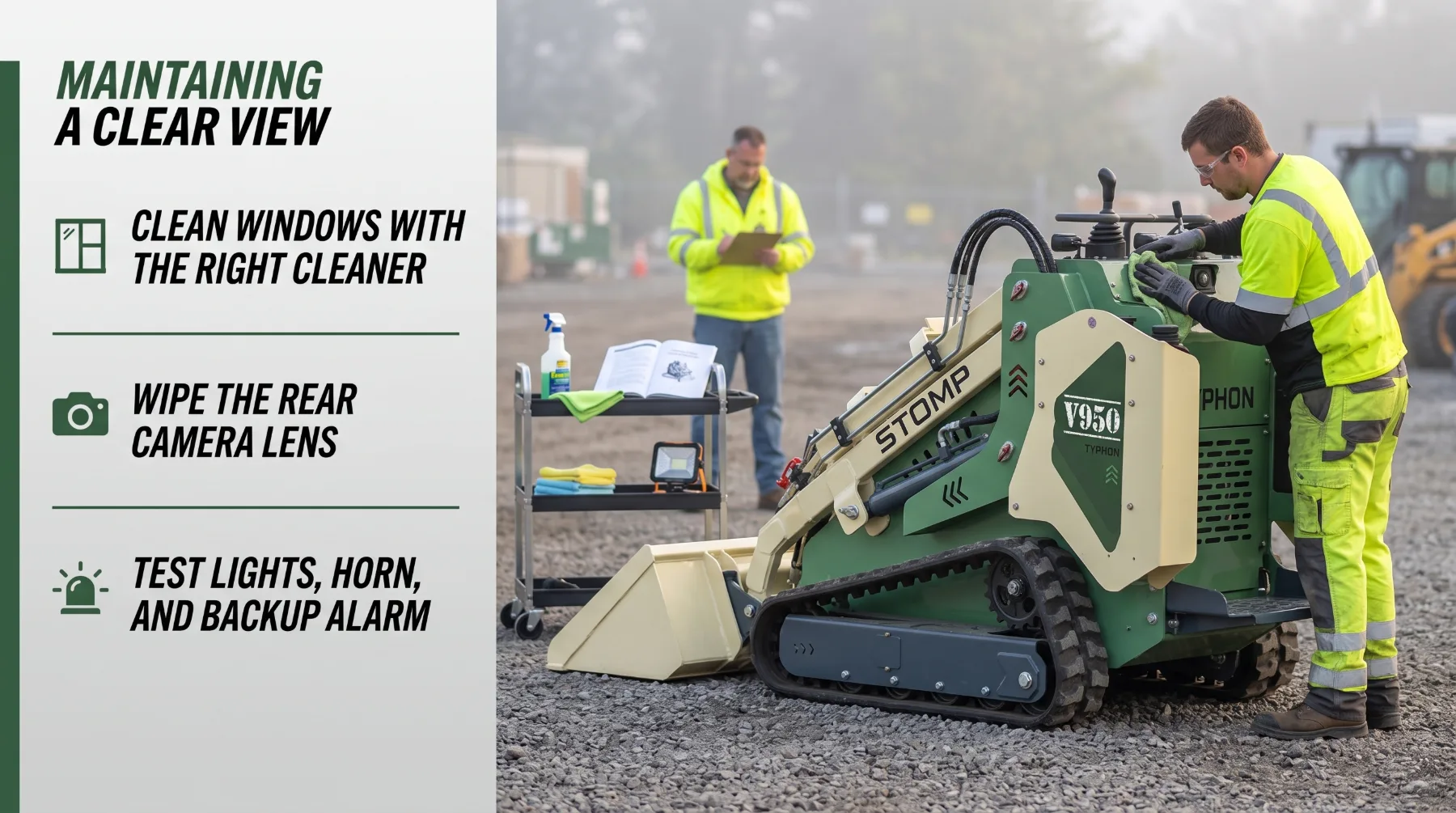
Every safe movement starts with what the operator can see. Skid steers sit low, have compact cabs surrounded by lift arms and frame structure, and often work in tight, busy spaces. Forward visibility at ground level is usually good, but a raised or loaded bucket blocks it. Side visibility is limited by the lift arms, especially when raised. Rear visibility is the most restricted of all. Spend time in the seat with the machine parked and have a coworker walk around the machine at various distances to map exactly where visibility disappears.
Clean windows, mirrors, and cameras before every shift. Use the cleaner the manufacturer recommends on polycarbonate doors, since dry rags and abrasive cleaners scratch the surface and turn every light source into glare. Replace scratched, cracked, or clouded panels before they cause a near miss. Clean the rear camera lens before the first move and again during the shift whenever mud or dust builds up. Adjust mirrors from the seated position after the seat is set, and replace cracked or missing mirrors before operating. Test front and rear work lights, the beacon, the horn, and the backup alarm at the start of every shift. Replace burned-out lights promptly.
When the operator can't see a target from the seat, the answer is never to lean out of the cab. Leaning out with live controls places the operator's body in the path of the lift arms. Lower the load, reposition the machine for a better angle, or use a trained spotter to guide the final move. If you must leave the seat, lower the attachment to the ground, set the parking brake, and shut off the engine first.
Key takeaway: Keep windows, mirrors, cameras, and lights clean and working before every shift, map your machine's blind spots, and reposition or use a spotter instead of leaning out of the cab.
Control Movements and Machine Stability
Skid steers respond quickly to control inputs, and that responsiveness affects stability. A short machine with a heavy load raised out front can tip forward, rock backward, or lose traction faster than many operators expect. Sudden joystick movements shift the load and the machine's center of gravity, spill material, and rock the machine onto its front wheels or tracks. Smooth inputs give the operator time to feel the machine's response and give nearby workers time to react.
Ease into travel rather than pushing the joystick to its limit. Slow down before turning, not during the turn. Feather lift and tilt inputs when placing loads, and avoid counter-rotating with a heavy, raised load. Keep the bucket or attachment low during travel, just high enough to clear the ground and obstacles. Raise the load only when the machine is stopped and positioned to dump or place material. Never travel with a load raised to see beneath it. On slopes, keep the heavy end of the machine pointing uphill. Drive forward going up and reverse coming down when loaded, and reverse going up and drive forward coming down when empty. Travel straight up and down slopes rather than across them, and avoid turning on grades. Regular hydraulic maintenance, including checking fluid levels, inspecting hoses and fittings for leaks, and replacing hydraulic fluid and filters according to the manufacturer's schedule, helps maintain responsive controls, reliable lifting performance, and safe machine operation.
Every skid steer has a rated operating capacity listed in the manual and on the machine. Check the rated capacity for the installed attachment before handling heavy loads, confirm the true weight from delivery tickets or supplier data, and leave a margin for slopes and soft ground. Fasten the seat belt and lower the seat bar every time you operate. If the machine begins to tip, stay in the seat, hold on, and lower the load if you can.
Key takeaway: Use smooth, deliberate inputs, carry loads low, keep the heavy end uphill on slopes, stay within rated operating capacity, and keep the seat belt fastened and seat bar lowered at all times.
Managing Blind Spots and Pedestrians
Skid steers can counter-rotate, accelerate quickly, and reverse almost instantly. That makes the area around the machine especially dangerous for people on foot, who often assume that because they can see the machine, the operator can see them. The rear of a skid steer is usually the hardest area to see, and site noise such as a reefer compressor, a generator, or traffic can drown out backup alarms entirely. A person stepping behind the machine to move a pallet jack may be completely invisible to the operator and unable to hear the warning.
On occupied sites, fence or barricade the work zone and mark pedestrian walkways that route people around the machine's travel and attachment areas. Schedule material deliveries and foot traffic for windows when the machine works elsewhere, and post signs at every zone entrance. Use a trained spotter whenever anyone on foot is nearby. A spotter stands where the operator can see them, outside the machine's travel path, uses agreed hand signals or radio calls, and has clear authority to stop the machine. The operator stops immediately whenever the spotter disappears from view or sends a stop signal.
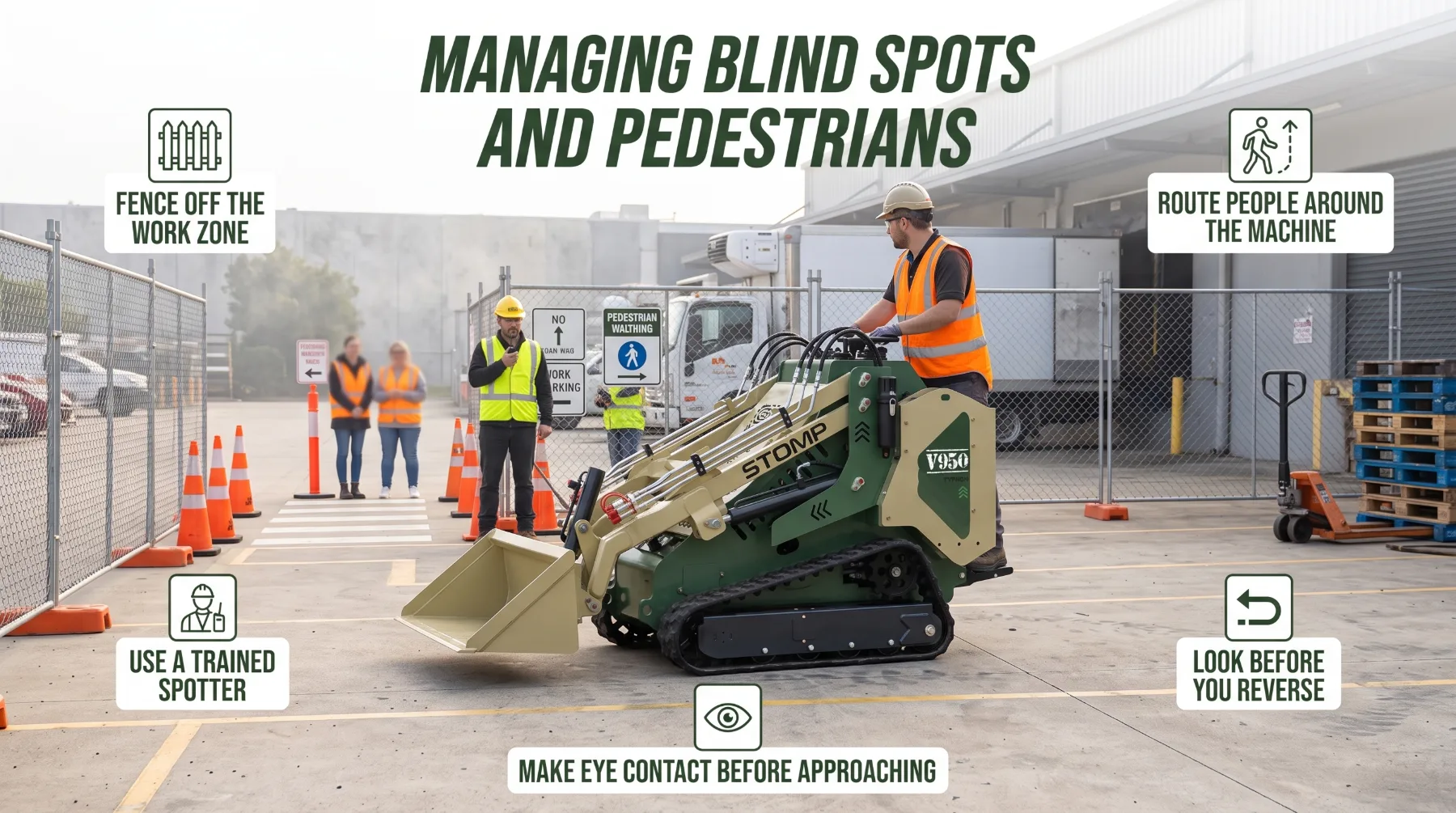
Everyone on foot in the work zone should use marked walkways, make eye contact with the operator before approaching, never walk under raised lift arms or loads, and avoid earbuds that block warning sounds. Operators look in the direction of travel before every movement, slow down at corners and doorways, sound the horn in congested areas, and stop when anyone enters the zone. Look up before raising the arms, since raised lift arms can contact overhead power lines, eaves, and canopies. In the United States, maintain at least 10 feet of clearance from energized lines up to 50 kV.
Key takeaway: Fence the work zone, route pedestrians around travel and attachment areas, use trained spotters with clear signals, and look in the direction of travel before every movement, especially before reversing.
Attachment Visibility and Safe Handling
Attachments make skid steers versatile, and they also change what the operator can see and how the machine handles. A heaped bucket blocks the view ahead. Pallet forks with a tall load hide the travel path. A wide angle broom conceals objects at its outer edges. Before using any attachment, sit in the seat with it installed and identify what it blocks, both with the attachment lowered and raised.
Verify a secure connection after every attachment change. Visually confirm both locking pins have passed fully through the mounting slots, tilt the attachment against the ground and tilt it back, then raise it slightly and watch the coupler for movement. Confirm hydraulic connections are fully engaged and auxiliary flow matches the attachment's requirements. Carry buckets and grapples low, tilted back slightly to hold material. Carry forks low with the load against the backrest. When the attachment blocks the forward view, travel in reverse while looking in the direction of travel where the manual permits, or use a trained spotter. Never raise a load to see beneath it while traveling.
Change attachments on firm, level ground away from traffic. Lower the attachment, shut off the engine, and relieve auxiliary hydraulic pressure before disconnecting hoses. Wipe couplers clean and cap them when disconnected. For auxiliary functions such as grapple clamping, auger rotation, and broom angle, learn which button controls each function before connecting the attachment, keep people clear of moving attachment parts, and disengage auxiliary hydraulics before anyone approaches.
Key takeaway: Identify what each attachment hides before using it, verify a secure coupler lock after every change, carry loads low and balanced, and use reverse travel or a spotter when the forward view is blocked.
Control Inspection and Operator Training
Controls and visibility aids protect people only when they work as designed and the operator knows how to use them. Before each shift, with the machine parked on firm, level ground, the attachment lowered, and the engine off, inspect the joysticks or levers for sticking, binding, or failure to return to neutral. Check for torn or missing rubber boots around joystick bases, damaged buttons or switches, and excessive play. Start the engine and test each function slowly in a clear area. Watch for hesitation, inconsistent movement, or functions that drift with controls in neutral.
Test safety systems every shift. Raise the seat bar and confirm that travel and loader functions lock out. Confirm the seat switch and parking brake engage as designed. Check the seat belt for secure latching and fraying. If any interlock fails, tag the machine out of service. Include visibility and warning devices in every inspection: windows, doors, and panels for cleanliness, cracks, and scratches; mirrors for damage and adjustment; the rear camera lens and display; work lights and the beacon; the horn and backup alarm. Check hydraulic hoses and fittings for leaks, abrasion, and damage using a piece of cardboard, never by running your hand along the hose.
Train every operator on the exact machine configuration they'll use, including control pattern, response settings, every switch and display screen, interlocks, visibility limits, attachment connection, rated operating capacity, and startup and shutdown procedures. Experience on one skid steer doesn't transfer automatically to another. Practice in a clear, open area before production work. Record inspection results, defects, and repairs in a log with the date and hour meter reading, and confirm repairs are complete before the machine returns to service.
Key takeaway: Inspect controls, interlocks, visibility aids, and warning devices before every shift, tag out any machine with a safety defect, and train every operator on the exact machine configuration before production work.
Conclusion
Safe skid steer operation depends on an operator who understands every control and maintains clear awareness of the surrounding work area. Confirming the control pattern and response settings before each shift helps prevent unexpected movements, while clean windows, properly adjusted mirrors, clear camera displays, and working lights improve visibility. Exclusion zones, barriers, and trained spotters help protect people from blind spots and moving equipment. Smooth control inputs, carrying loads low, and following machine-specific slope and capacity limits support stability during travel and material handling. Correct attachment installation and daily inspections also help prevent dropped loads, hydraulic leaks, and equipment failures. Before every shift, park on firm, level ground with the attachment lowered and parking brake set, then inspect joysticks, levers, pedals, boots, and switches for damage or restricted movement. Check hydraulic hoses and fittings for leaks, using cardboard rather than your hands to locate suspected high-pressure leaks. Clean windows, doors, panels, and camera lenses with recommended products, adjust mirrors from the seated position, and test work lights, the beacon, horn, and backup alarm. Fasten the seat belt, lower the seat bar, confirm the control pattern indicator matches your training, and select suitable drive and hydraulic response settings for the day's tasks. Test the seat bar, seat switch, and parking brake interlocks according to the operator's manual. Verify each attachment using a visual coupler check, ground test, and any manufacturer-required lift test, then confirm the rated operating capacity for the installed attachment. Walk the work zone to identify pedestrians, overhead lines, slopes, and obstacles, and ensure barriers, walkways, and exclusion zones are established. Agree on hand signals or radio calls with the spotter, then test machine functions slowly in a clear area before starting work. Tag out the machine and report any defect that affects safe operation. To reinforce consistent practices across the fleet, select a standard control pattern where appropriate, label it in each cab, and require operators to confirm the pattern indicator before moving. Machine-specific training, reliable safety systems, and consistent pre-shift checks help protect crews and nearby workers while supporting dependable jobsite performance.
Frequently Asked Questions
Do all skid steers use the same controls?
No. Control layouts vary by model, so operators should learn the specific machine before use. Skid steers may use hand-and-foot controls, mechanical hand controls, or joysticks. Many joystick machines also offer selectable ISO and H patterns, which assign travel and loader functions differently. Confirm the pattern indicator every time you climb in, test each function slowly in a clear area, and get machine-specific training before production work.
Why are skid steer blind spots important?
The machine's structure and attachments can hide people or obstacles, especially during turns and reversing. The rear of a skid steer is often the hardest area to see, and raised lift arms limit side visibility. Because skid steers can counter-rotate and change direction quickly, a person standing in a blind spot can be struck within seconds. Use exclusion zones, trained spotters, clean mirrors and cameras, and always look in the direction of travel.
What should operators do when an attachment blocks visibility?
Use an approved travel method that maintains a safe view, or arrange a spotter according to site procedures. Depending on the manual, that may mean traveling in reverse while looking in the direction of travel, or using a trained spotter for forward travel. Break large loads into smaller ones when possible. Never raise a load to see beneath it while traveling, since that reduces the machine's stability.
How can operators maintain precise control?
Use smooth inputs, suitable speed, proper attachment positioning, and the manufacturer's operating guidance. Set drive and hydraulic response to a moderate level for grading, loaded travel, and work near people. Rest your arms on the armrests, slow down before turning, and carry loads low. Inspect controls daily for sticking, play, or damaged boots, and report any problem before continuing work.